EcoUnplug

Bees, Butterflies and Other Pollinators:
The Effects of Radiofrequency Radiation Exposure
Alarming rates of decline have been seen across the globe in bee species, as well as in pollinators and other insects.
While pesticide use, habitat destruction, and climate change play major roles in this decline, current research suggests an additional man-made factor in radiofrequency (RF) radiation emitted from modern wireless technologies.
Scientists have documented diverse negative impacts of RF radiation from cellular and wireless technologies in bees and other insects, including problems with navigation, hive abandonment, and declines in bee reproduction following placement of cell towers and related infrastructure near bee colonies and habitats. However, recent generations of mobile communication technologies have been deployed without environmental testing of potential toxic effects.

"Bees and monarch
butterflies, among others, are already in trouble here in Maine and elsewhere. These millimeter wavelengths resonate with animal and plant tissues particularly of these smaller organisms whose sizes are comparable in size to the millimeter frequency lengths."
The scientific research referenced below describes the biological effects and mechanisms of exposure to man-made RF radiation and associated electromagnetic fields on bees and insects.
Biologists have long known that bees have magnetite granules present in their abdomens which have enabled them to use the Earth's natural magnetic field for navigation. However, in recent decades the Earth's naturally occurring magnetic field has become increasingly clouded by the man-made magnetic fields that accompany wireless and cellular devices and supportive infrastructures.
As the density of wireless infrastructure has grown worldwide, electromagnetic pollution is no longer limited to urban areas with dense human populations. Bees and other insects in rural, remote, and protected areas are now being impacted. Some scientists have pointed out that areas untouched by pesticides or habitat destruction have still seen dramatic bee and insect declines. Biologists searching for causes have documented detrimental effects from man-made RF radiation reaching into otherwise protected environments.

Behavioral effects in honey bees 7 days after cellular exposure: 2025
Migdał et al. (2025) studied the impact of 900 MHz radiofrequency radiation, a frequency utilized worldwide in cellular communications, on honey bee behavior. The researchers assigned the bees to 9 experimental groups exposed to three levels of radiation: intensities at 12 V/m, 28 V/m, and 61 V/m. Observed bee behaviors included flying, social interactions, walking, and self-grooming.
"Significant effects were observed seven days
after exposure in walking, flight, and
individual contact."
Migdał, P.; Plotnik, M.; Bieńkowski, P.; Berbeć, E.;
Latarowski, K.; Białecka, N.; Murawska, A.
The Influence of an Electromagnetic Field at
a Radiofrequency of 900 MHz on the
Agriculture
Abstract: The development of wireless technology and the desire to improve communication electromagnetic fields (EMFs) of various frequencies have become common across the honey bee’s foraging landscape. There has been discussion for many years about the possible impact of electromagnetic fields on living organisms. Artificial radio fields emit frequencies ranging from 100 kHz to 300 GHz. The presented research aimed to demonstrate the influence of the radiofrequency electromagnetic field (RF-EMF) with a frequency of 900 MHz on the behavior of honey bees in laboratory conditions. For this experiment, we used wooden cages to house honey bee workers immediately after they emerged. Bee workers were divided into control and experimental groups. Bees in the control group were not exposed to RF fields, while the experimental groups were exposed to 900 MHz electromagnetic fields of different intensities and durations of exposure. Bees’ behavior was analyzed with an appropriate computer program. Behavioral analysis of bees was performed immediately after exposure and seven days after exposure. Our research has shown that the radio field (900 MHz) affects the behavior of bees compared to the control group, although not all results are statistically significant. Significant effects were observed seven days after exposure in walking, flight, and individual contact. However, it is worth extending the study to include the impact of an RF-EMF on the expression of genes responsible for bee behavior.
Pollinator Decline and Wireless Radiation
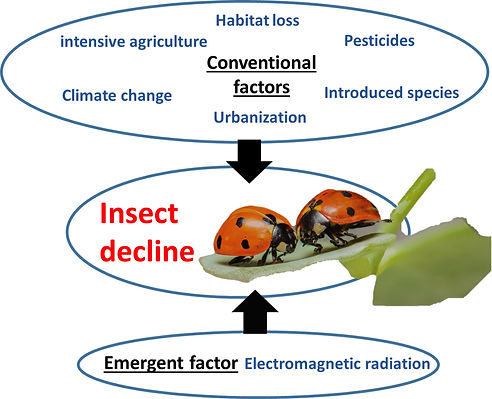
Although worldwide reductions in bee and other insect diversity have largely been attributed to agricultural practices and pesticide use, this review describes evidence of damage caused by electromagnetic radiation and suggests that electromagnetic radiation should be considered seriously as a complementary driver for the dramatic decline in insects.
"The review carried out in this study shows that
electromagnetic radiation should be considered seriously
as a complementary driver for the dramatic decline
in insects, acting in synergy with agricultural
intensification, pesticides, invasive species
and climate change."
Alfonso Balmori, 2021
Electromagnetic radiation as an emerging
driver factor for the decline of insects
Science of The Total Environment
Abstract: The biodiversity of insects is threatened worldwide. Numerous studies have reported the serious decline in insects that has occurred in recent decades. The same is happening with the important group of pollinators, with an essential utility for pollination of crops. Loss of insect diversity and abundance is expected to provoke cascading effects on food webs and ecosystem services. Many authors point out that reductions in insect abundance must be attributed mainly to agricultural practices and pesticide use. On the other hand, evidence for the effects of non-thermal microwave radiation on insects has been known for at least 50 years. The review carried out in this study shows that electromagnetic radiation should be considered seriously as a complementary driver for the dramatic decline in insects, acting in synergy with agricultural intensification, pesticides, invasive species and climate change. The extent that anthropogenic electromagnetic radiation represents a significant threat to insect pollinators is unresolved and plausible. For these reasons, and taking into account the benefits they provide to nature and humankind, the precautionary principle should be applied before any new deployment (such 5G) is considered.
5G Effects: Higher Absorption
Published in the journal Scientific Reports, Thielens et al. conducted research on Western Honey Bees (apis mellifera) to provide estimates of realistic
radiofrequency (RF) exposure and absorption, using a combination of numerical simulations and exposure measurements in the field. They examined RF absorption in five simulated honey bee models: two workers, a drone, a larva, and a queen. In parallel they measured environmental RF exposure near five bee hives in Belgium to quantify the real exposure of honey bees. The measured values were then used to rescale the numerical simulations to quantify real absorption levels.
The scientists looked at shifts in power densities and what these shifts might impact the honey bees' absorption levels of the radiation. Power densities under 3 GHz, which correspond approximately to 4G and low-band 5G, were compared with higher power densities in the high-band 5G range.
The research showed that a small increase in power density lead to a very large increase in absorbed power. The frequency power absorbed by the honey bees' bodies may increase up to a hundredfold when there is a change from 4G (including some low-band 5G) up to the high-band 5G range at 26 GHz.
"A relatively small shift of 10% of environmental incident
power density from frequencies
below 3 GHz to higher frequencies
will lead to a relative increase in absorbed power
of a factor higher than 3."
- Thielens, Greco, Verloock,
Martens and Joseph, 2020
Radio-frequency electromagnetic field exposure
of western honey bees

Biological effects of electromagnetic fields on insects: a systematic review and meta-analysis: 2024
Thill et al. reviewed 185 papers on the effects of electromagnetic fields (EMF) on insects, and 145 studies on insect magnetic sensing. They observed the following trends for high frequency (HF) EMFs (238 experiments): decreased reproductive capacity in 37 percent of experiments, altered behavior (18%), oxidative stress (10%), DNA damage (7%) and impaired development (5%). For low frequency (LF) EMFs (133 experiments), 29 percent of experiments found a behavioral effect, 12% found metabolic effects, and 11% reproductive effects.
"The existence of consistent results from numerous studies conducted by various research groups using various protocols make an irrefutable case for adverse effects of low-power LF- and HF-EMF on insects."
In addition, the review found that significant toxic effects were still found among 31 of the 36 HF-EMF studies that used field strengths of less than 6 V/m (~100mW/m2), i.e., below regulatory thresholds (International Commission on Non-Ionizing Radiation Protection).
Thill, Alain, Cammaerts, Marie-Claire and Balmori, Alfonso. "Biological effects of electromagnetic fields on insects: a systematic review and meta-analysis" Reviews on Environmental Health, vol. 39, no. 4, 2024, pp. 853-869. https://doi.org/10.1515/reveh-2023-0072

Nutritional markers in honey bees exposed to cellular radiofrequencies: 2024
Migdał et al. (2024) examined how radiofrequency electromagnetic fields affect the nutrition of Carniolan worker honey bees. Measurements to assess the honey bees' nutrition levels were taken, including total proteins, glucose, triglycerides,and total antioxidant status (TAS) activity in bee hemolymph. The honey bees were exposed to 900 MHz radiofrequency radiation, a frequency commonly used in mobile communications. The study found that exposed bees showed signs of cellular starvation, even at exposure levels that were below current safety standards.
"Radiofrequency electromagnetic fields disturb
honey bee nutrition. The changes may have
long-term effects."
Migdal, P.; Plotnik, M.; Bieńkowski, P.; Murawska, A.;
Berbeć, E.; Sobkiewicz, P.; Zarębski, K.; Latarowski, K., 2024
Changes in honey bee nutrition after exposure to
radiofrequency electromagnetic field.
The European Zoological Journal
In the bee groups exposed to 12 V/m and 28 V/m, statistically significant differences were found in the activity of biochemical markers (total proteins, TAS, and triglycerides) compared to the unexposed control group in most cases. "Under the influence of the radiofrequency electromagnetic field, the level of protein in the bee hemolymph in the study groups was significantly lower than in the control group." Significantly lower concentrations of glucose were found in the hemolymph in most of the bee groups compared with the control group. A decrease in the activity of the oxidative system after exposure to the radiofrequency field was also seen.
Longer lasting disturbances in the bees' physiological processes began in the 28 V/m and 61 V/m groups. The authors suggested that these physiological changes could be affected by duration of time spent in the radiofrequency electromagnetic field at given intensities. However, even at the lowest level measured, 12 V/m, the honey bees suffered a 59 percent drop in essential proteins and experienced glucose fluctuations from +60% to -47%. The scientists also found significant triglyceride disruption and weakened antioxidant defenses in the exposed bees.
Abstract: Urban beekeeping has gained interest in recent years. Bees placed in cities, on the roofs of buildings, are exposed to many different sources of electromagnetic fields of different frequencies and intensities. Knowledge about the impact of electro-magnetic fields on the physiology and behavior of insects (including honey bees) is limited. Hence, one of the first steps was to check how radiofrequency electromagnetic fields affect honey bees’ nutrition. The level of total proteins, glucose, triglycerides, and TAS activity in bee hemolymph was analyzed. This is because they indicate the honey bee’s nutrition level. The experiment involved 2-day-old Carniolan worker honey bees (Apis mellifera carnica L.). The bees were exposed to fields of 12 V/m, 28 V/m, and 61 V/m for 0.25, 1 and 3 h. Hemolymph was taken from 40 alive worker honey bees from each group immediately after exposure, by removing the antennae with sterile tweezers. The activity of biochemical markers (total proteins, TAS, and triglycerides) in the bee hemolymph in 12 V/m and 28 V/m groups showed statistically significant differences compared to the control group in most cases. According to our own research, radiofrequency electromagnetic fields disturb honey bee nutrition. The changes in the analyzed indicators may have long-term effects.

A Cell Phone in the Hive:
Bees Disappear
Scientists studied the effects of cell phone emissions on honeybee behavior. Using 900 MHz radiofrequencies, which are the frequencies utilized worldwide in cellular communications, they observed four honeybee hives. Two of the hives had cell phones placed inside, and two of the hives were observed without cell phones. For the two hives with cell phones, the scientists turned the phones on for 15 minutes, twice a day.
They noted that the colony began to decline and oviposition rates, or the queen's rates of egg laying, dropped significantly. The number of incoming foragers declined, and worker bees were observed having difficulty returning to their hives. Large losses in worker bee numbers followed. The experiment was conducted twice a week from February to April.
After three months of the experiment, the colony had no honey or pollen reserves due to changes in the forager bees' behavior.
"We have compared the performance of honeybees in cellphone radiation exposed and unexposed colonies... The behaviour of exposed foragers was negatively influenced by the exposure, there was neither honey nor pollen in the colony at the end of the experiment."
"There was neither honey nor pollen in the colony
at the end of the experiment."
Sharma, V.P. and Kumar, Neelima R., 2010
Changes in honey bee behaviour and biology under the influence of cell phone radiations.
Current science.

Colony Collapse Not Fully Explained by Pesticide Use, Plant Biodiversity Loss 2017
Biologist Marie-Claire Cammaerts performed a simple experiment on honeybees consisting of counting the bees coming into and out of the hive, either with or without a cell phone at the hive entrance.
She argues that insecticides, pesticides, parasites, fungi and predators, and decreases in plant biodiversity are all harmful to bees, but do not fully explain the nearly world-wide decline of domestic bees known as the colony collapse disorder (CCD).
She notes that the onset of steep declines in bee populations does not line up with the onset of pesticide use; bee declines began much later. Similarly, the incidence of CCD did not decrease when insecticide and pesticide use became controlled and limited. In addition, when insecticides or pesticides are present, bees are found dead all around their hive, whereas in many cases of CCD there are no dead bees seen either inside the hive or all around the hive. Instead, the number of bees in the hive simply drops dramatically.
Abstract:
The decline of domestic bees all over the world is an important problem still not well understood by scientists and beekeepers, and far from being solved.
Its reasons are numerous: among others, the use of pesticides and insecticides, the decrease of plant diversity, and bee’s parasites. Besides these threats, there is a potential adverse factor little considered: manmade electromagnetism. The production of electromagnetic waves by human settlements, cellphones relay and power lines largely increases nowadays. Bees are very sensitive to this electromagnetism. The present paper suggests two simple experimental protocols for bringing to the fore the potential adverse effect of electromagnetism on bees and to act consequently. The first one is the observation of bees’ avoidance of a wireless apparatus; the second one is the assessment of colonies’ strength and of the intensity of the electromagnetism field (EMF) surrounding them. If bees avoid a wireless apparatus, if hives in bad health are located in EMF of a rather high intensity, it can be presumed that bees are affected by manmade electromagnetism. This should enable searching for palliative measures.
Cammaerts M. (2017) Is electromagnetism one of the causes of the CCD? A work plan for testing this hypothesis. J Behav 2(1): 1006

"The expected peaks of daily activity, common among insects at the morning and afternoon, were only observed for honeybees surveyed around inactive towers, or else, those located far from the towers with active energy transmission."
Pollination Issues Near Transmission Towers: 2023
Molina-Montenegro et al. found that honeybees exposed to radiofrequency electromagnetic fields (EMFs) showed enhanced expression of heat-shock proteins and genes involved in antioxidant activity, as well as affected behavior-related genes expression. In addition, flowers growing near EMF emissions received fewer honeybee visits and produced fewer seeds than those growing far from the emissions. Differences were found in richness of plant species and plant abundance in areas closer vs. farther from the EMF emissions.
"The presence of EMF under field conditions
significantly impaired honeybees’ pollination services to plants
following a putative molecular mechanism associated with behavioral and physiological stress...
Abstract: We assessed the effect that electromagnetic field (EMF) exerts on honeybees’ pollination efficiency using field and laboratory experiments. First, we measured levels of gene and protein expression in metabolic pathways involved in stress and behavioral responses elicited by EMF. Second, we assessed the effect of EMF on honeybee behavior and seed production by the honeybee-pollinated California poppy and, lastly, by measuring the consequences of pollination failure on plants’ community richness and abundance. EMF exposure exerted strong physiological stress on honeybees as shown by the enhanced expression of heat-shock proteins and genes involved in antioxidant activity and affected the expression levels of behavior-related genes. Moreover, California poppy individuals growing near EMF received fewer honeybee visits and produced fewer seeds than plants growing far from EMF. Last, we found a hump-shaped relationship between EMF and plant species richness and plant abundance. Our study provides conclusive evidence of detrimental impacts of EMF on honeybee’s pollination behavior, leading to negative effects on plant community.
Molina-Montenegro MA, Acuña-Rodríguez IS, Ballesteros GI, Baldelomar M, Torres-Díaz C, Broitman BR, Vázquez DP. Electromagnetic fields disrupt the pollination service by honeybees. Sci Adv. 2023 May 12;9(19). doi: 10.1126/sciadv.adh1455. Epub 2023 May 12.

Bees Initiate Piping Sound in Response to Cell Phone: Communication of Danger (2011)
Favre and colleagues placed mobile phones in 5 different honeybee hives and then took more than 80 sound recordings during the next five months (February through June 2009). When the cell phone was off, the bees remained undisturbed. When the cell phone was turned on, the impact was dramatic: The sounds made by the bees increased in intensity and frequency within 25 to 40 minutes of turning the phone on, resulting in a "worker piping signal." The worker piping sound is usually produced by bees as a signal to swarm and leave the hive sue to danger or other disruption. If the cell phone was turned off immediately, the bees calmed down within 2 or 3 minutes. If the cell phone was left on for 20 hours and then turned off, the bees continued their piping signal for up to an 12 hours. The effect was consistent and repeatable. This study demonstrated distinct adverse effects after exposure to cell phone radiofrequency radiation.
"The present data strongly suggest that honeybee colonies are affected and disturbed by electromagnetic waves (RF-EMF)."
Favre, Daniel. April 2011. Mobile phone-induced honeybee worker piping
Link: https://www.jscimedcentral.com/Behavior/Articles/behavior-2-1010.pdf


Queen Bee Hatching Rates Reduced: 2019
Scientists exposed the queen larvae of honey bees to the radiation emissions of a common mobile phone during their pupation and other stages of pre-adult development. After 14 days of exposure, they assessed the hatching of adult queens; after another 11 days they assessed the mating success of surviving queens.
"Chronic RF-EMF exposure significantly reduced hatching of honey bee queens."
Abstract: Mobile phones can be found almost everywhere across the globe, upholding a direct point-to-point connection between the device and the broadcast tower. The emission of radiofrequency electromagnetic fields (RF-EMF) puts the surrounding environment inevitably into contact with this radiation. We have therefore exposed honey bee queen larvae to the radiation of a common mobile phone device (GSM band at 900 MHz) during all stages of their pre-adult development including pupation. After 14 days of exposure, hatching of adult queens was assessed and mating success after further 11 days, respectively. Moreover, full colonies were established of five of the untreated and four of the treated queens to contrast population dynamics. We found that mobile phone radiation had significantly reduced the hatching ratio but not the mating success. If treated queens had successfully mated, colony development was not adversely affected. We provide evidence that mobile phone radiation may alter pupal development, once succeeded this point, no further impairment has manifested in adulthood. Our results are discussed against the background of long-lasting consequences for colony performance and the possible implication on periodic colony losses.
Odemer, Richard et al. Effects of radiofrequency electromagnetic radiation (RF-EMF) on honey bee queen development and mating success. Science of The Total Environment, Vol. 661, 2019, 553-562.

Dect Phone Exposure:
Delayed Return to the Hive
Grölle and colleagues performed experimental research using to examine the effects of irradiating honeybees. Using Dect cordless phones, they observed that the irradiated bees were far less able to come back to their hives within ordinary time frames.
Grölle L, Chapin A, Cotte D, Cabanettes F. The impacts of electromagnetic waves on bees and their consequences. Revue Etudiante d’Evaluation Environnementale. 2010; 1: 1-7.

Media and Headlines: Bees and Other Insects
The Atlantic:
If Cell Phones Are Behind the Bee Decline, What Are They Doing to Humans?
June 2010
“...Researchers fitted cell phones to a hive and powered them up for two fifteen-minute periods each day. After three months, they found the bees stopped producing honey, egg production by the queen bee halved, and the size of the hive dramatically reduced.”
"Andrew Goldsworthy, a biologist from Imperial College, London, told CNN that the reason may have to do with radiation from cell phones and cell towers disturbing the molecules of the chemical cryptochrome, which bees and other animals use for navigation.”


Fox News:
Cell Phones Caused Mysterious Worldwide Bee Deaths, Study Finds
Published 2011, updated 2015
CNN:
Study Links Bee Decline to Cell Phones
June 2010, by Sasha Herriman
The reason could hinge on a pigment in bees called cryptochrome. "Animals, including insects, use cryptochrome for navigation," Andrew Goldsworthy, a biologist from the UK's Imperial College, London, told CNN.
They use it to sense the earth's magnetic field "and their ability to do this is compromised by radiation from [cell] phones and their base stations. So basically bees do not find their way back to the hive."


AFP (Agence France Presse)/Barron's
September 17, 2020:
Mobile Phone Radiation May Be Killing Insects: German Study
Daily Mail
2011:
Why a mobile phone ring may make bees buzz off: Insects infuriated by handset signals.
-
Describes research conducted by Dr. Favre, a retired biologist with the Swiss Federal Institute of Technology in Lausanne. Dr. Favre stated: ‘This study shows that the presence of an active mobile phone disturbs bees – and has a dramatic effect.’
-
Two mobile phones were placed under a beehive, and recordings were made of the high pitched calls made by the bees. Three sets of recordings were made: (1) when the handsets were switched off, (2) when they were placed on stand-by mode, and (3) when the handsets were activated. Approximately 20 to 40 minutes after the phones were activated, the bees began to emit “piping” calls – a series of high pitched squeaks that announce possible danger and preparation for swarming.